Audiological Service
We are committed to providing professional, diverse, and reasonably priced hearing services for anyone concerned about their hearing health — from those with identified hearing loss to individuals who feel their hearing may be changing. Our professional team consists of audiologists and hearing technicians, using advanced equipment to provide hearing assessments, hearing aid fitting and adjustment services. With the support of speech therapists and social workers, we promote overall hearing, speech, and social well-being.
Who can use our services?
- Regular Audiology Services (Subvented by The Social Welfare Department)
Any holder of Hong Kong Identity Card or Hong Kong Birth Certificate of all-age is eligible to apply. - Self-Finance Audiology Services
Any person with/ without Hong Kong Identity Card or Hong Kong Birth Certificate of all-age is eligible to apply.
Hearing Test Process & Video
Hearing Test Process
Step 1: Consultation & Interview
Understand your situation, medical history, and daily needs.
Step 2: Ear Canal Examination
Use an otoscope to check the health of your ear canal.
Step 3: Hearing Test
Conduct a pure-tone test to assess your hearing level.
Step 4: Report Explanation
Explain your "audiogram" on the spot so you clearly understand your hearing status.
Step 5: Personalized Recommendation
Provide tailored solutions, from communication strategies to hearing aid trials.
Frequently Asked Questions (FAQ)
1. How do I read an audiogram?
The audiogram is arranged from left to right according to frequency, ranging from low-mid frequencies to high frequencies (125 Hz–8000 Hz). From top to bottom, it represents sound intensity levels from very soft to very loud sounds (-10 dB to 120 dB).
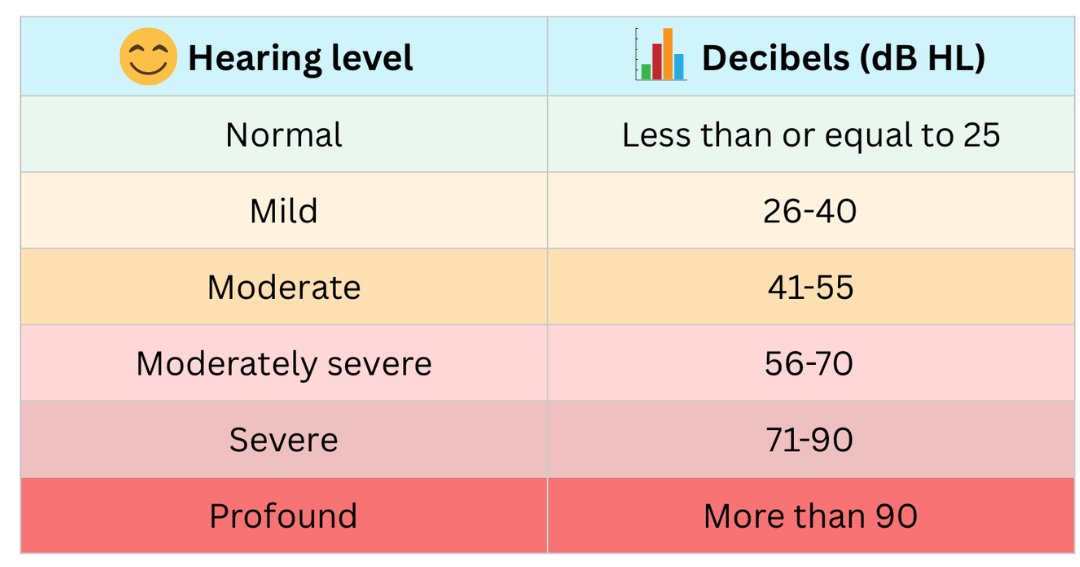
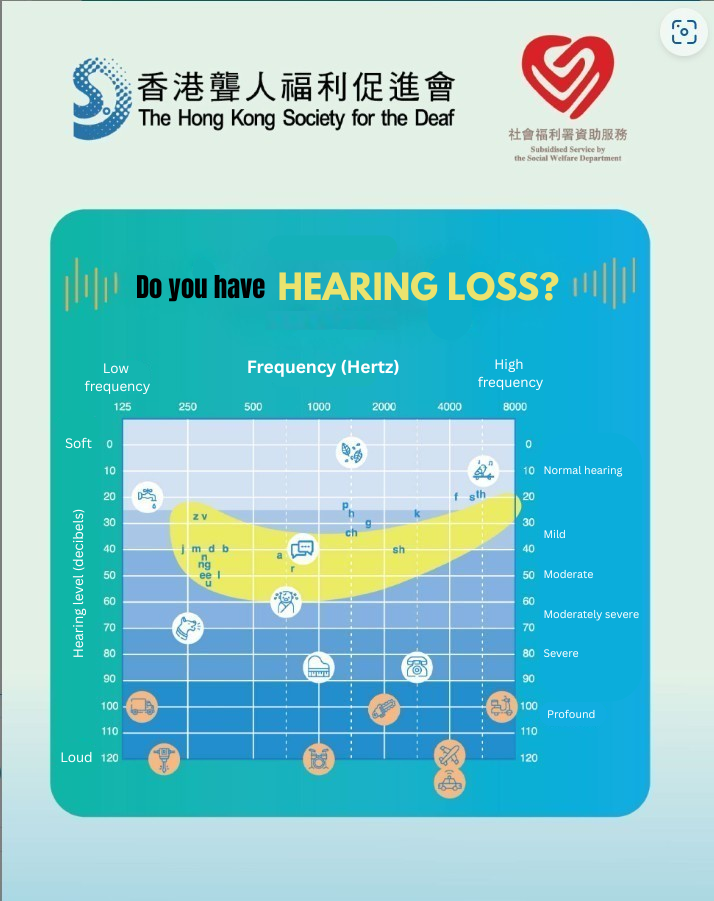
Click the image to enlarge and view details
2. How can I choose a suitable hearing aid?
- Appearance is one factor to consider when choosing a hearing aid. Common styles include Receiver-in-Canal (RIC) and In-the-Ear (ITE) hearing aids.
- For individuals with more severe hearing loss who require higher amplification power, Behind-the-Ear (BTE) hearing aids are generally the preferred choice.
- If the hearing loss mainly affects high frequencies (for example, difficulty understanding speech while low-frequency hearing remains relatively good), Receiver-in-Canal (RIC) hearing aids are usually the most recommended option.
- The price of a hearing aid depends mainly on its technology level (basic, mid-range, or premium) and the brand. Costs can range from a few thousand dollars to several tens of thousands of dollars.
- Almost all hearing aid styles except RIC models require a custom-made earmold or shell, which generally provides better comfort and performance.
- Both RIC and In-the-Ear (ITE) hearing aids require the regular replacement of wax guards to prevent earwax buildup from affecting sound quality and overall performance.
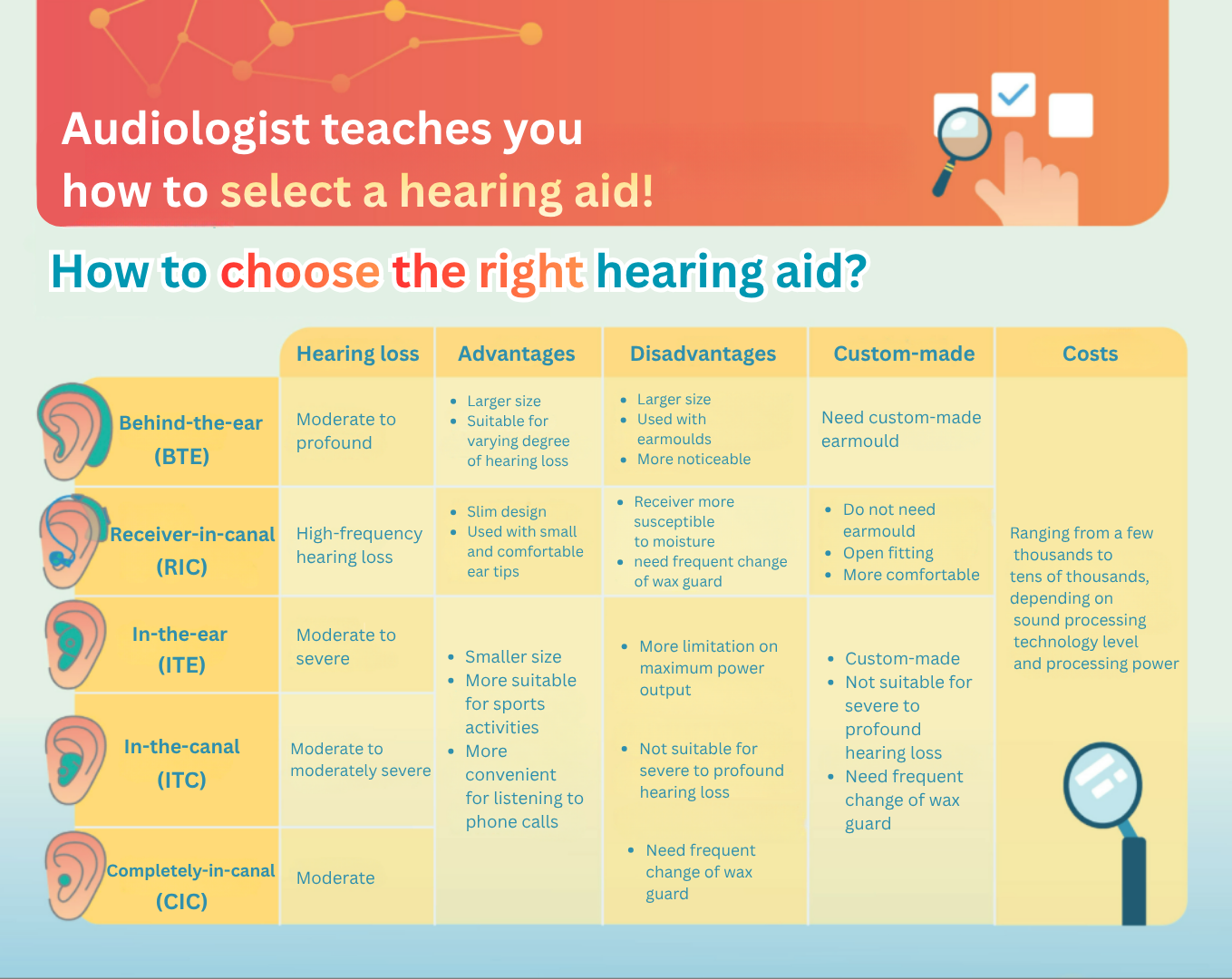
Click the image to enlarge and view details
3. I have recently experienced tinnitus in one ear. Can it be improved or treated?
4. When an elderly family member experiences sudden dizziness due to balance problems in the inner ear, how should a caregiver respond?
5. Sudden hearing loss may cause a rapid loss of hearing within a short period of time. Are there any warning signs, and is recovery possible?
6. There are many ear-cleaning products on the market, such as ear drops and cotton buds. How should I choose the right one?
7. What are the different levels of hearing loss?
8. Sometimes I cannot hear clearly, and sometimes I miss certain sounds. Does this mean I may have hearing loss?
9. What are the main types of hearing aids, and how should I choose one?
10. An elderly family member may often have difficulty hearing others, and may therefore feel frustrated or upset easily. What should I pay attention to when communicating with them?
11. What home assistive devices are available for elderly people with hearing difficulties?
12. How can caregivers manage their emotions when caring for an elderly person with hearing difficulties?
Service Center Overview
Audiology Centre (Tseung Kwan O)
Address: 6/F, Sheung Mei House, Sheung Tak Estate, Tseung Kwan O, N.T.
Tel: 2179 3160
Fax: 2761 4390
WhatsApp: 5623 9119
Email:audiology@deaf.org.hk

Audiology Centre (Tuen Mun)
Address: 105-108, G/F, Ting Lung House, On Ting Estate, Tuen Mun, N.T.
Tel: 2711 5728
Fax: 2861 1985
WhatsApp: 9518 1729
Email:audiology@deaf.org.hk
Audiology Centre (Hung Hom)
Address: Unit F, 2/F, Sunshine Plaza, 17 Sung On Street, Hung Hom, KLN. (Please use the entrance opposite to the Kowloon City Government Offices)
Tel: 2711 3873
Fax: 2711 0098
WhatsApp: 5395 0966
Email:audiology@deaf.org.hk

Outreach Audiometric Screening
| Welfare Organizations | HK$1800 (Half day) HK$3000 (Full day) |
| Private Organizations | HK$7000 (Half day) HK$12000 (Full day) |
Mobile Vehicle Audiometric Screening
| Welfare Organizations | HK$2200 (Half day) HK$3400 (Full day) |
| Private Organizations | HK$9000 (Half day) HK$14000 (Full day) |
Hearing Conservation Talk
| Standard Fee | HK$1500 each time |
| Welfare organizations discounts | 20% off (HK$1,200) |
How We Help
Our Services
Disclaimer | Privacy Policy | Website Map | Web Accessibility Conformance Statements
The Hong Kong Society for the Deaf ©2026